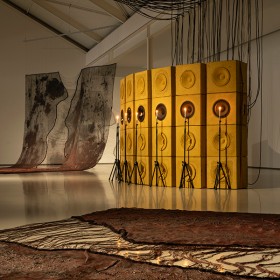
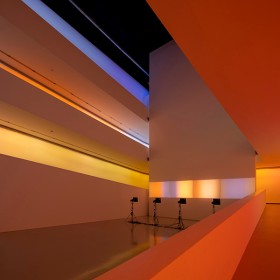
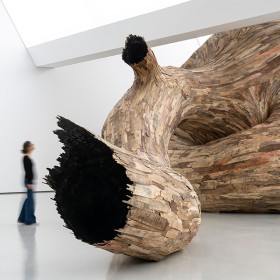
ANATOMY OF PRESENCE is not conceived as a conventional group exhibition. Instead, it brings together three distinct presentations that enter into dialogue with one another. All three artists – Vivian Caccuri, Lucia Koch, and Henrique Oliveira – developed their works specifically for the exhibition, responding to the particular architectural conditions of the SCHAUWERK, with its large shed hall and former high-bay warehouse.
What connects their three artistic approaches, despite their very different appearances, is an interest in sensory perception and the role of the body within it. Sound and vibration, light and colour, material and spatial expansion cannot be grasped through vision alone. As we move through the installations, we ourselves become part of the situations they create. Here, presence also means becoming aware of our surroundings, of the presence of others, and of our own bodies. The exhibition seeks to heighten this awareness.
The French philosopher Maurice Merleau-Ponty (1908–1961) wrote that the body is our general medium for having a world. The philosopher Gilles Deleuze (1925–1995) and the psychoanalyst Félix Guattari (1930–1992) proposed defining a body not through its anatomical and biological characteristics, but through its affects. The concept of “embodiment” can be understood in relation to such a view of the body. Researchers in fields including cognitive science, philosophy, and psychology use the term to describe the close interrelationship between body, perception, and mind. Experience is not understood as the product of mental processes alone, but as something that emerges through the interplay of bodily presence and our sensory relationship with the environment. The body, then, does not merely function as a “container for the mind”, but as an active medium through which the world first becomes perceptible and meaningful to us.
In a present increasingly shaped by screens and virtual experiences, this understanding takes on renewed significance. Presence means more than simply being physically located in a particular place. It describes a state of attentiveness in which we consciously engage with our surroundings through perception. As we move through the exhibition together with other visitors, the idea of a collective body also begins to emerge: individual perception remains intact, yet becomes part of a shared space of experience.
In art-historical terms, the three artists can be situated within a particular tradition of Brazilian art. From the late 1950s to the 1960s, a distinctive form of installation-based and participatory art developed in Brazil in which direct bodily experience increasingly moved to the foreground. Artists such as Lygia Clark, Hélio Oiticica, and Lygia Pape no longer understood art solely as a visual object, but as something that could be experienced with the whole body – through movement, touch, spatial perception, and active participation. This interest continues to resonate in Brazilian art today. As the art works in the exhibition demonstrate, sensory experience and conceptual thought are not opposites: sound, colour, light, and material can have an immediate physical and perceptual effect while at the same time raising social or philosophical questions.
The artists’ shared geographical and cultural context is not the central theme of the exhibition, but it opens up an additional level through which their three positions can be understood. Brazil is marked by cultural and social complexity as well as striking contrasts: densely built metropolitan areas meet vast natural landscapes, and formal structures coexist with informal ones. Different aspects of these tensions can also be traced, in distinct ways, in the works of Caccuri, Koch, and Oliveira.
The Collectors and Brazil
The idea for the exhibition ANATOMY OF PRESENCE, which features three Brazilian artists, was inspired by the collectors Peter Schaufler (1940–2015) and Christiane Schaufler-Münch (1934–2025).
As the owner and CEO of the BITZER Group, Peter Schaufler considered it his life’s work to connect entrepreneurship with support for art, science and research. BITZER is the world’s largest independent manufacturer of refrigeration compressors with sales companies and production sites all over the globe. In the 1970s Peter Schaufler and Christiane Schaufler-Münch moved to Brazil to strengthen BITZER’s presence and build closer relationships with the local market. His commitment to the country was so profound that he became a Brazilian citizen. BITZER’s history in Brazil dates back to the 1950s, when the first low-speed open-type compressors were introduced to the country. By the 1990s, Brazil had evolved into the hub of BITZER’s Latin American operations, laying the foundation for the company’s continued growth across South America. Today, BITZER Brasil employs around 150 people and serves as a key pillar of the BITZER Group’s activities in the region.
For Peter Schaufler and his wife the years they spent in São Paulo were formative. The city's cultural diversity, vibrant arts scene and urban dynamism left a lasting impression on the couple that was a contrast to their everyday lives in Stuttgart. They discovered their passion for the Brazilian way of life and experienced a time that they described in retrospect as the happiest of their lives.
ANATOMY OF PRESENCE carries over this special attitude towards life in the SCHAUWERK, opened by the couple in 2010. The unique architecture of the museum, which was once a manufacturing hall and warehouse of the Bitzer company, provides an ideal backdrop.