Credits
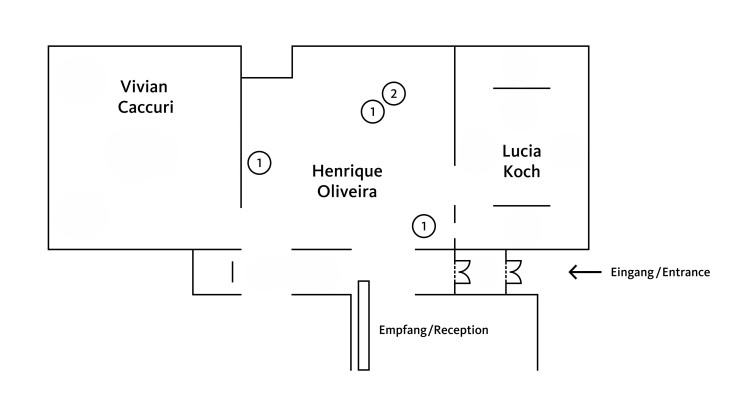
1 = Henrique Oliveira, Burned Bridges, Eternal Return, 2026, Found plywood, plywood, charcoal, papier-mâché, plaster, paint, and metall, © Henrique Oliveira, Courtesy of Almeida & Dale Gallery, São Paulo and Galerie GP&N Vallois, Paris
2 = Henrique Oliviera, Oito de Paus, 2021, Tree bark, branch bits, cardboard, plywood, and glue, © Henrique Oliveira, Courtesy of Almeida & Dale Gallery, São Paulo and Galerie GP&N Vallois, Paris
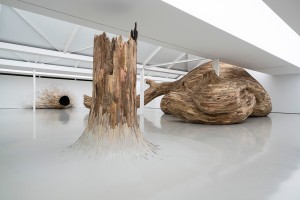
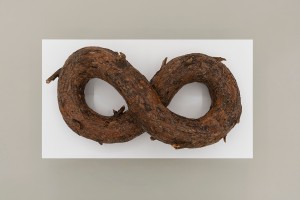
Henrique Oliveira (*1973) is known for his expansive wood installations. His three-part work Burned Bridges, Eternal Return is architectural in scale and was constructed entirely on site over the course of several weeks. It responds directly to the architecture of the shed hall, almost merging with it: trunk-like elements burst from the floor and walls, while a large biomorphic growth swells up in the centre, reaching almost to the roof. The different shades of brown in the wood and the curving forms create a striking contrast with the orthogonal architecture and white surfaces of the museum. As a result, the work appears almost like a living organism spreading through the space.
A characteristic feature of Oliveira’s installations is his use of found plywood. The thin pieces are broken by hand and layered over a wooden substructure. The artist regards the varying colours and stains of the aged wood as a “painterly” quality, placing pieces of different hues alongside one another like brushstrokes. Oliveira began his artistic career as a painter and continues to paint to this day. In his work, the boundaries between painting, sculpture, and architecture deliberately remain fluid.
Through his choice of material, Oliveira refers to the urban environment of Brazilian cities such as São Paulo. Known as “tapumes” (from the Portuguese “tapar”, meaning “to cover” or “to conceal”), plywood panels are commonly used there as construction fences. Once they are no longer needed for this purpose, they may be reused as building material by residents of the favelas – low-income settlements that have developed in urban interstitial spaces and on the outskirts of cities. The material therefore refers both to the constantly changing metropolis, shaped by demolition and new construction, and to the social inequalities within Brazilian society.
At the same time, plywood is a natural material that has been industrially processed. Once a tree, it becomes a building material and eventually waste. Oliveira collects this discarded material and transforms it into structures that once again resemble organic, growing forms. The title Burned Bridges, Eternal Return can also be understood in relation to this cycle. The expression “to burn one’s bridges” describes an irreversible break that makes a return impossible. This is juxtaposed with the idea of “eternal return”. What appears finished and used up returns in Oliveira’s work in an altered form. This evokes a phenomenon that can be observed in Brazil just as much as anywhere else in the world: roots break through asphalt, while abandoned buildings are sooner or later reclaimed by vegetation.
Movement is central to the experience of the work. Oliveira invites visitors to wander through the space, circle the wooden structures, and explore their spatial relationships from different perspectives. The central section of the installation functions both as a sculptural object and as a space that can be entered. Passing through its cave-like entrance, visitors arrive in a smaller white-cube gallery in which the work Oito de Paus (2021) is presented. Its bark-covered surface initially resembles a naturally grown tree trunk, yet its form contradicts this impression. It describes a horizontal figure eight, the symbol of infinity.
The spatial structure of the installation plays with a related idea. It recalls a Matryoshka, the traditional Russian wooden doll that contains a smaller version of itself, which in turn contains another. One structure thus reappears within itself. In Oliveira’s installation, this repetition is not only visible but can also be experienced physically as we pass through one spatial layer after another. Here, the central motif of the entire work becomes particularly tangible: the idea of repetition, return, and a potentially endless cycle.
Biography
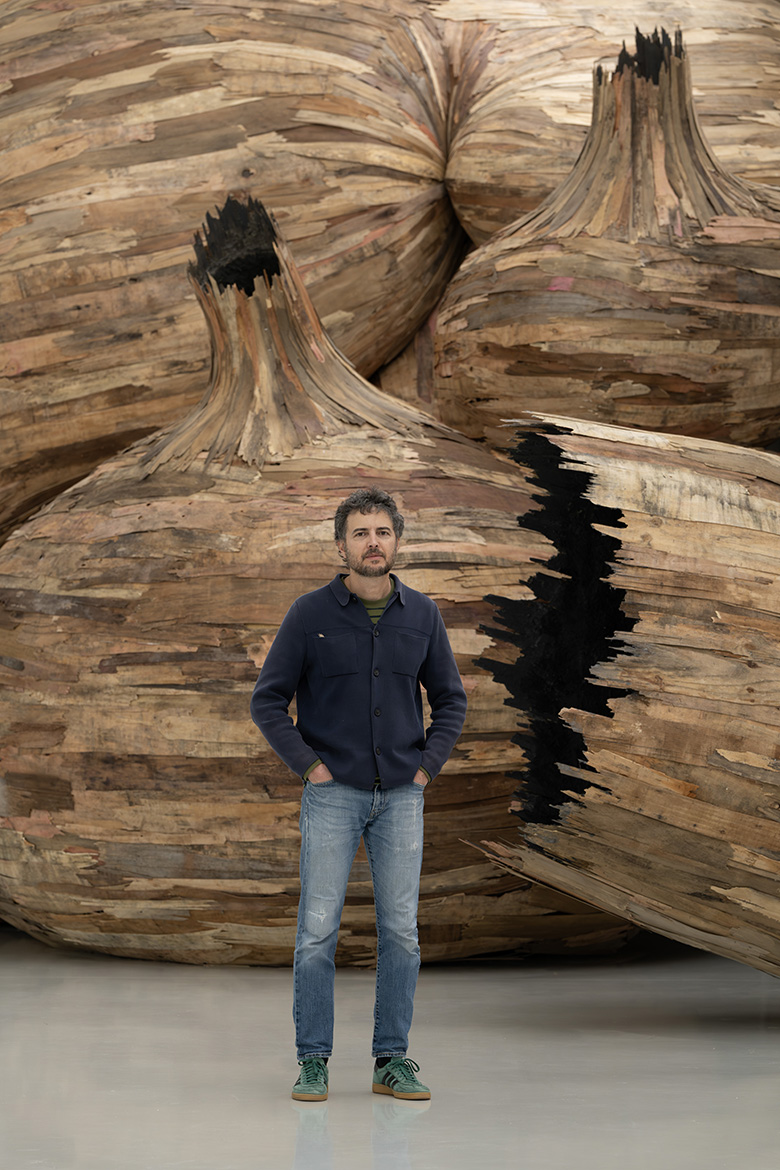
Henrique Oliveira
Born in 1973 in Ourinhos, Brazil.
Lives and works in São Paulo, Brazil, and London, UK.
His work has been shown in several solo and group exhibitions, including:
2025: Whispers on the Horizon (14th edition of the Taipei Biennal), Taiwan; Archistories. Architecture in Art, Staatliche Kunsthalle Karlsruhe, Germany.
2023: Memento Habilis, Galeria Millan, São Paulo, Brazil.
2015: Fissure, Galerie Georges-Philippe & Nathalie Vallois, Paris, France.
2014: Transarquitetonica, Museu de Arte Contemporânea, São Paulo, Brazil. 2013: Baitogogo, Palais de Tokyo, Paris, France; SAM Art Projects, Paris, France.
2012: Centro Municipal de Arte Hélio Oiticica, Rio de Janeiro, Brazil; Ursulinen Prolapse, Offenes Kulturhaus, Linz, Austria.
Oliveira’s work can be found in the permanent collections of numerous institutions and museums including Virginia Museum of Fine Arts, Richmond (VA), USA; the Museu Afro Brasil, São Paulo, Brazil; as well as Queensland Art Gallery, Brisbane, Australia. In 2010 was also chosen as the recipient of the prestigious Smithsonian Artist Research Fellowship and the Fountainhead Residency at Fountainhead Studios in Miami (FL), USA.