Credits
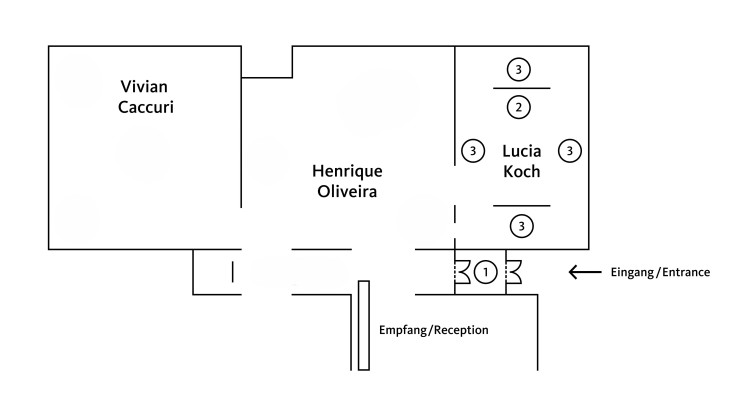
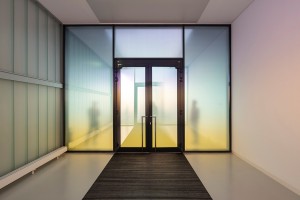
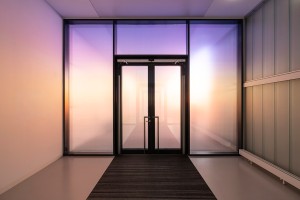
1 = Lucia Koch, Atmosphere Box, 2026, Print on adhesive vinyl, © Lucia Koch, Courtesy of the artist and Carlier Gebauer Gallery
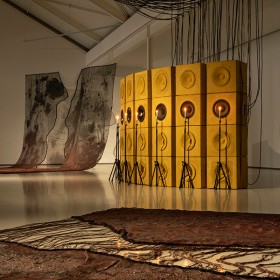
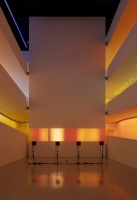
2 = Lucia Koch, Gang of Four (Runners), 2026, Projectors, tripods, colour scrollers, cables, piezo microphones, arduino, and speakers, © Lucia Koch, Courtesy of the artist and Carlier Gebauer Gallery
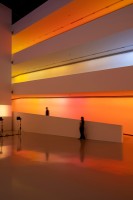
3 = Lucia Koch, Big Loop, 2026, Colour correction filters on fluorescent lamps, © Lucia Koch, Courtesy of the artist and Carlier Gebauer Gallery
L
Lucia Koch’s (*1966) artistic practice includes photography, video, sculptural works, and immersive installations. At the centre of her work is the question of how light, colour, and architecture shape our perception of space. Over the years, she has developed a number of different bodies of work around these concerns, often drawing inspiration from the sites themselves and responding to existing buildings and spatial situations. Koch regards architecture as a language that can be “read” and explored. Through her interventions, she investigates how people experience a space and move through it. For ANATOMY OF PRESENCE, the artist developed three works.
In the museum’s entrance vestibule, the work Atmosphere Box uses translucent films printed with colour gradients to filter the light entering through the glass surfaces. The opposing gradients evoke associations with sunrise and sunset, transforming the space in between into a timeless transitional zone. In this way, Koch alters not only our experience of space, but also our perception of time.
In the former high-bay warehouse, four modified projectors form the installation Gang of Four (Runners). They project a choreography of shifting light and colour atmospheres onto the wall. Each of the four projectors contains a colour scroller modified by the artist herself. These consist of filters made from long strips of transparent coloured film, on which several colours are arranged in sequence. Motorised rollers move the strips past a light source. Depending on which section of colour is positioned in front of the lamp, the light is filtered accordingly. The light is diffused in such a way that subtle colour gradients emerge, which, through the programming, appear to move across the wall. The effect recalls old slide or film projections, with the crucial difference that no images or narrative are presented – only shifting atmospheres of colour.
Many of Koch’s interventions, however, also make use of light that is already present on site. She understands light not merely as a means of illumination, but as a force that shapes spaces and influences our perception. A striking example is the work Big Loop. For this installation, Koch fitted more than 200 existing fluorescent tubes in the SCHAUWERK’s former 15-metre-high high-bay warehouse with colour-correction gels. These specialised filters are also used in film production to adjust lighting or simulate different times of day. With their help, the spiralling walkway is transformed into an enormous sequence of colour. As visitors move up and down the ramps, they pass through different colour atmospheres and experience the space as a succession of light, colour, and movement. Moving through the installation reveals constantly changing colour combinations, viewpoints, and spatial relationships. The visitor’s own body becomes the measure of this experience. The immersive nature of the work makes clear that light and colour are not experienced visually alone, but also act directly upon the body.
With Big Loop, Koch also takes up an idea by the Czech-Brazilian philosopher and communication theorist Vilém Flusser (1920–1991). In the 1990s, Flusser proposed the idea of a language made of colours. He suggested that computers would eventually make a virtually unlimited number of colours available and that it would therefore be only logical to develop from them a sophisticated language capable of expressing things that words and numbers cannot. In Big Loop, the sequences of colour can be “read” like a continuous text that resists rational interpretation – not with the eyes alone, but with the whole body, as we move through the space and become immersed in it.
Biography
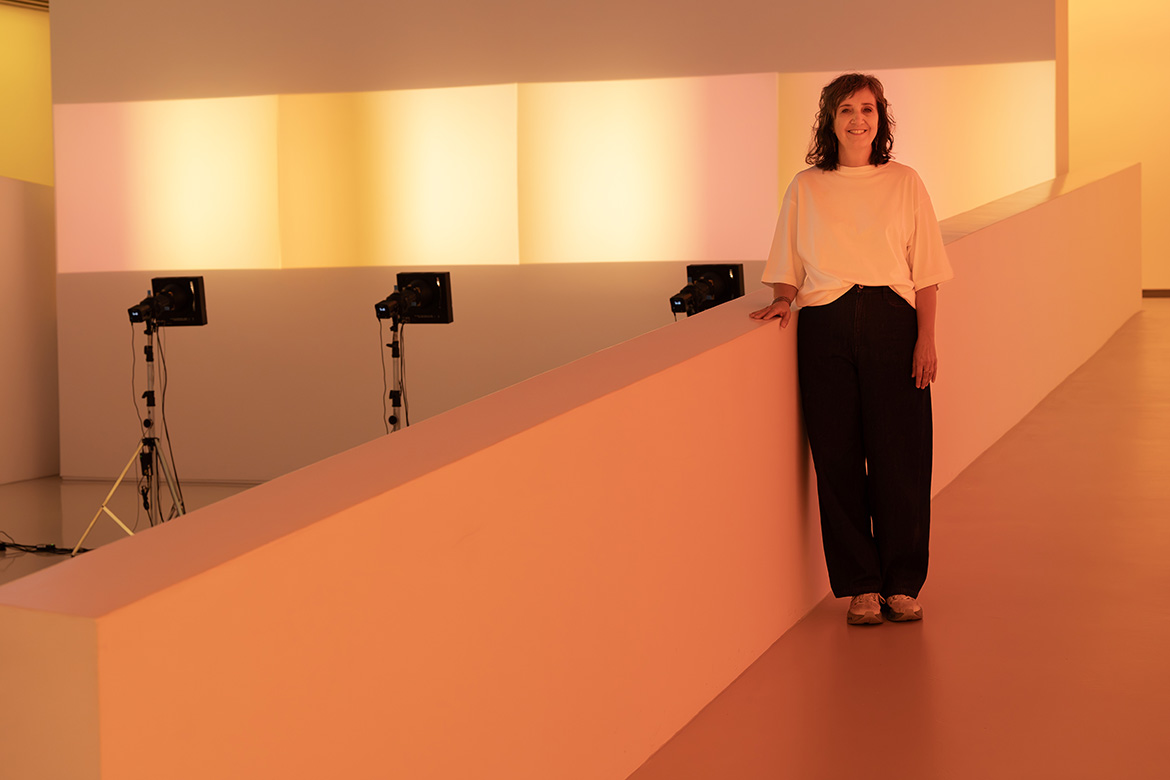
Lucia Koch
Born in 1966 in Porto Alegre, Brazil.
Lives and works in São Paulo, Brazil.
Her work has been shown in several solo and group exhibitions, including:
2025: MAC-RS, Porto Alegre, Brazil.
2024: Museo Madre, Naples, Italy.
2022: Tumulte, Palais d’Iéna, Paris, France.
2021: Regressão, Museu de Arte Contemporânea MAC-USP, São Paulo, Brazil; Propaganda, Instituto Inhotim, Brumadinho, Brazil.
2019: Casa de Vento, Lina Bo Bardi’s Casa de Vidro, São Paulo, Brazil; MAAT-Museu de Arte, Arquitetura e Tecnologia, Lisbon, Portugal.
2017: The Los Angeles Municipal Art Gallery (LAMAG), Los Angeles, USA.
2015: La Temperatura del Aire, Fundación Caja de Burgos, Spain.
2009: Yerba Buena Center for the Arts, San Fransisco, USA.
2008: MOT-Contemporary Art Museum, Tokyo, Japan.
Koch has participated in several Biennales, including the second edition of the Islamic Arts Biennale in Jeddah, Saudi Arabia; the first Public Art Abu Dhabi Biennial in the United Arab Emirates; the first Rabat Contemporary Art Biennial in Morocco; the first Architecture Biennale in Orléans, France; the 11th Sharjah Biennial in the United Arab Emirates; the 11th Lyon Bienniale in France; the first Aichi Trienniale in Nagoya, Japan; the 27th São Paulo Biennial in Brazil; the third Göteborg International Biennial for Contemporary Art in Sweden; as well as the eight Istanbul Biennial in Turkey.