Credits
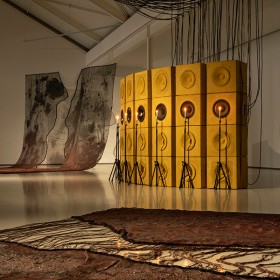
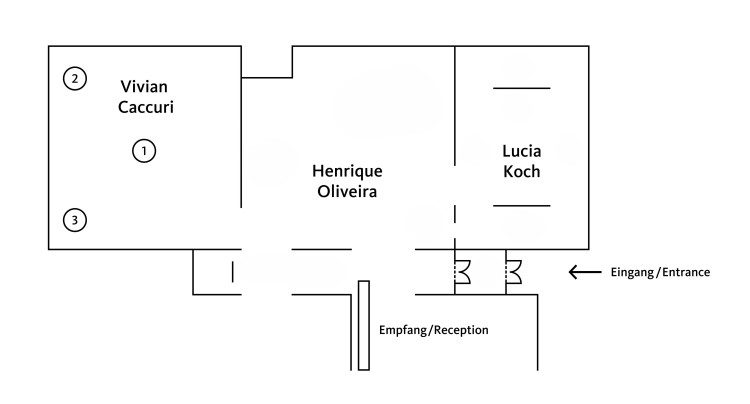
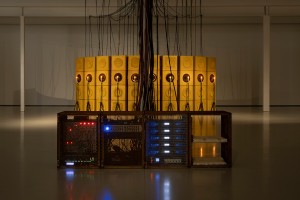
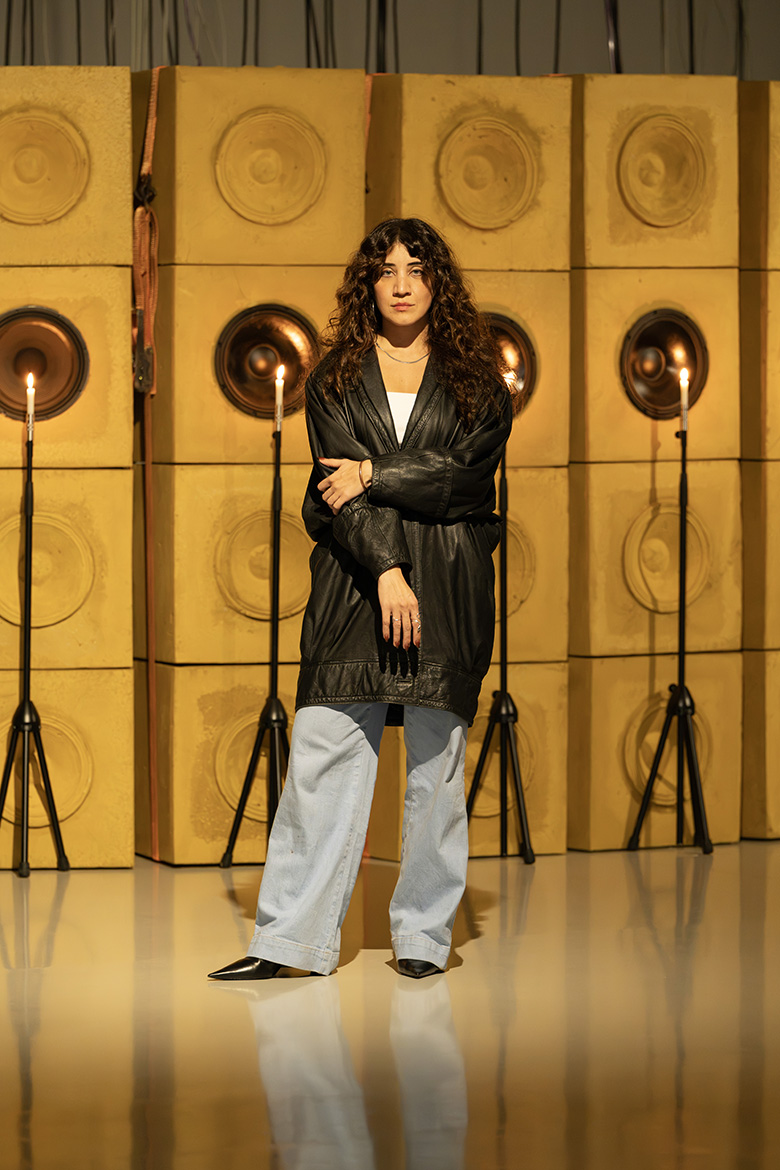
1 = Vivian Caccuri, Overheated System, 2026, Concrete boxes, iron oxide, speakers, cargo straps, analogue synthesiser, amplifiers, audio cables, microphone stands, and candles, © Vivian Caccuri, Courtesy of Vivian Caccuri Studio
2 = Vivian Caccuri, Ash Fossil I, 2026, Mosquito screen, cotton, polyester, acrylic resin, acrylic, charcoal, and iron oxide, © Vivian Caccuri, Courtesy of Vivian Caccuri Studio
3 = Vivian Caccuri, Ash Fossil II, 2026, Mosquito screen, cotton, polyester, acrylic resin, acrylic, charcoal, and iron oxide, © Vivian Caccuri, Courtesy of Vivian Caccuri Studio
Vivian Caccuri (*1986) explores how sound shapes perception, affects the body, and connects people with one another through installations, sound sculptures, performances, and textile works.
For ANATOMY OF PRESENCE, she developed the expansive sound installation Overheated System. At its centre is an analogue, modular synthesizer system custom-built for the work according to the artist’s specifications. Caccuri configured and connected the system herself, thereby establishing the sonic conditions under which it operates. Three oscillators generate vibrations at different frequencies, which are then combined with one another. Frequency determines pitch, while the shape of the waveform influences the character of the sound. In this way, Caccuri composes the resulting soundscape to a certain degree without fully determining how it unfolds. The interaction of its individual elements produces a continuously shifting sonic landscape that permeates the entire space.
In her presentation, which includes not only Overheated System but also the two tapestries Ash Fossil I and Ash Fossil II, Caccuri refers to the French writer and philosopher Georges Bataille (1897–1962) and his concept of an excess of energy. Bataille proposed that surplus energy that cannot be used for growth or directed towards a specific purpose must ultimately be expended. Caccuri takes up this idea and translates it into acoustic, bodily, and material processes.
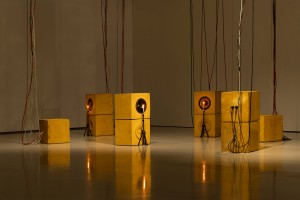
Low frequencies travel through the space, moving the air and causing the candle flames positioned in front of the loudspeakers to flicker. In this way, the invisible vibrations become visible while also being physically perceptible.
The installation evokes a church interior as a place of gathering and collective experience. Caccuri sees parallels between religious rituals, concerts, raves, and parties. A wall of loudspeakers structures the installation like an altar and invites visitors to gather in front of it. The body itself becomes a resonating chamber, perceiving the vibrations not only through hearing but directly and physically.
The numerous cable connections play a central role. They refer to the phenomenon known in Brazil as “gatonet”: improvised and usually irregular telecommunications networks. For Caccuri, such structures represent complex connections and flows whose origins and pathways can often no longer be traced. Accordingly, some of the cables serve specific functions, while others simply create the impression of a dense network. Some of the loudspeakers encased in yellow concrete are dummies, appearing like remnants of a system that has fallen out of operation or is waiting to be reactivated.
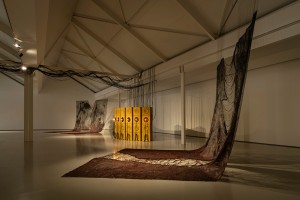
The two tapestries Ash Fossil I and Ash Fossil II are made from mosquito netting and treated with iron oxide and acrylic paint. Oxidation processes alter their coloration, making chemical transformation visible. Wave-like openings in the fabric recall graphic representations of sound waves, while broad layers of iron oxide disrupt the regularity of the netting.
As porous fabrics, the tapestries enter into a conceptual dialogue with Overheated System. While sound, vibration, and movement become immediately perceptible in the installation, temporal and material processes of transformation are inscribed directly into the surfaces of the tapestries.
Biography
Vivian Caccuri
Born in 1986 in São Paulo, Brazil.
Lives and works in Rio de Janeiro, Brazil.
Her work has been shown in several solo and group exhibitions, including:
2025: Fantasma Boca, Fondazione Antonio Ratti, Como, Italy and Ocean Space, Venice, Italy.
2024: Febre da Selva Elétrica, Galeria Municipal do Porto, Portugal; Phantom Dust, in: 6 1⁄2 Weeks, Folkwang Museum, Essen, Germany.
2022: The Shadow of Spring, New Museum, New York, USA.
2021: The Musical Brain, High Line Arte, New York, USA.
2019: Febre Amarela, A Gentil Carioca, Rio de Janeiro, Brazil; 58. Venice Biennale, Venice, Italy; The Shape of a Circle in the Mind of a Fish with Plants, Serpentine Galleries, London, United Kingdom.
2018: Água Parada, Museu de Arte Contemporáneo de Niterói, and Galeria Leme, São Paulo, Brazil; Kochi-Muziris Biennale, India.
2017: Future Generation Art Prize at PinchukArtCenter, Kiev, Ukraine, and Palazzo Contarini Polignac, Venice, Italy.
2012: Funarte Award for Critical Production in Music.
Caccuri’s works are in the collections of the Pinacoteca do Estado de São Paulo, Brazil; Gilberto Chateaubriand Collection in Museu de Arte Moderna do Rio de Janeiro, Brazil; Inhotim Institute, Brumadinho, Brazil; Pérez Art Museum Miami (FL), USA, and Institute of Contemporary Art, Miami (FL), USA, and Museum Berggruen, Berlin, Germany.