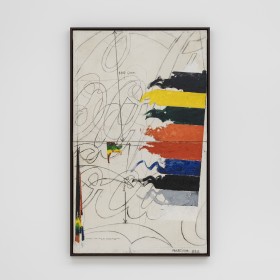
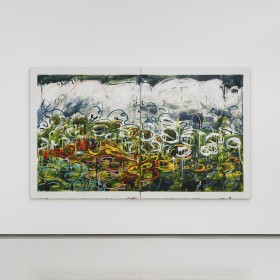
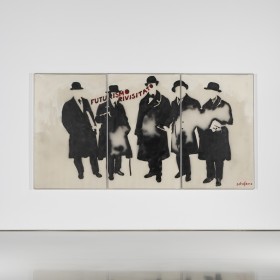
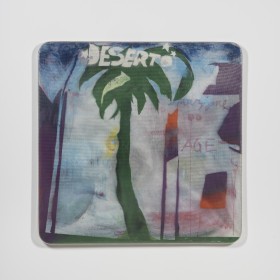
1934
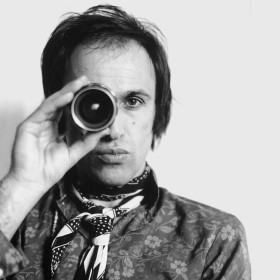
Mario Schifano is born on September 20 in Khoms, Italian Libya.
mid-1940s
After the end of the Second World War, Schifano’s family moves from Africa to Rome, Italy.
1951–62
After dropping out of school early, years of odd jobs, and completing military service, Schifano becomes his father’s assistant at the Etruscan National Museum in the Villa Giulia. In addition to this work in archaeology and restoration, he begins to paint.
1959
The artist’s has his first solo exhibition at Galleria Appia Antica in Rome.
1960
Schifano decides to become a painter.
His works are exhibited alongside those of Tano Festa, Franco Angeli, Francesco Lo Savio, and Giuseppe Uncini in the important group exhibition 5 Pittori – Roma 60, organized by Pierre Restany, at Galleria La Salita in Rome.
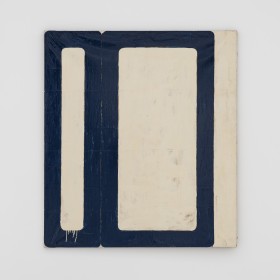
The Monochromi series of paintings—emblematic works inspired by everyday reality, such as large signs and zebra crossings—mattracts the interest of critics.
1961
First solo exhibition at Galleria La Tartaruga
The influential American gallerist Ileana Sonnabend signs Schifano as the first Italian artist in her gallery under an exclusive contract.
1962
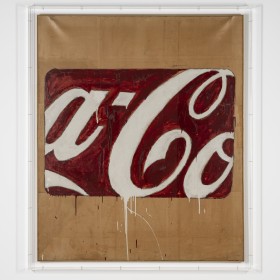
The motifs in Schifano’s paintings begin to change: Enlarged details from billboards find their way into his pictorial world. In particular, fragments of logos from Coca-Cola, Esso, and Cities Service Company become recurring elements in the painter’s works.
Schifano participates in the important group exhibition International Exhibition of the New Realists at Sidney Janis Gallery in New York. Other featured artists Andy Warhol, Tom Wesselmann, Roy Lichtenstein, and Mimmo Rotella. From then on, Schifano is considered by many to be an important protagonist of Italian Pop Art.
1963
With the relocation of Galleria La Tartaruga to Piazza del Popolo in Rome, a loose association of like-minded artists forms. Rather than private studios, they preferred the Caffè Rosati and the public space of the square itself as places of exchange and creativity. In addition to Schifano, Tano Festa and Franco Angeli, and later Jannis Kounellis and Pino Pascali, are among those who belong to this so-called Scuola di Piazza del Popolo.
Ileana Sonnabend dedicates a solo exhibition to Schifano in her Paris gallery. However, due to differing views on Schifano's artistic development, the collaboration ends that same year. Works with landscape references became increasingly prevalent.
Schifano presents a solo exhibition, Tutto, at Galleria Odyssia in Rome.
Together with Anita Pallenberg, Schifano makes his first trip to the United States in December. There, he meets numerous artists and writers, including Frank O’Hara, Jasper Johns, Jim Dine, and Andy Warhol. During his six-month stay in New York City, he maintains a studio and works almost incessantly on drawings and sketches. He also begins to explore the medium of film and shoots his first short films.
1964
Schifano is invited to participate in the 32nd Venice Art Biennale. The exhibition helps Pop Art achieve its international breakthrough. In the three works he shows there, Schifano deals with Italian Futurist painting, among other things.
1965
With True Love, Schifano presents his first solo exhibition at the newly founded Studio Marconi, Giorgio Marconi’s important Milan gallery. Marconi represents the artist until 1970.
Schifano participates in the 8th São Paulo Art Biennial, Brazil.
1966
First arrest for drug possession. Further arrests follow in 1969, September 1971, December 1973, April 1975, and December 1982.
1966–67
Schifano begins work on the series Tuttestelle and Compagni, Compagni.
1967
On December 28, the music group Le Stelle di Mario Schifano, initiated by Schifano, plays one of its first concerts at the Piper Club in Rome. Sequences filmed by Schifano and projections of hand-painted color slides and transparencies accompany the music visually. This concert is considered Italy’s first multimedia live show.
Also around 1967, Schifano befriends the members of the legendary rock band The Rolling Stones.
1968–69
Filming of the trilogy Satellite, Umano non umano, and Trapianto, consunzione e morte di Franco Brocani
Due to an existential crisis, the artist retreats to his studio and even considers giving up painting altogether.
1969
The Rolling Stones release the song “Monkey Man,” inspired by and dedicated to Mario Schifano, on their studio album Let It Bleed.
Schifano spends time in Regina Coeli prison in Rome for drug possession. His glamorous lifestyle and drug excesses earn him the reputation of being a “cursed artist” (artista maledetta) and make him the subject of tabloid headlines. His brief relationship with the British singer Marianne Faithfull also fuels media interest.
1970
Schifano travels to the United States again, this time with Nancy Ruspoli. The purpose of the trip is to research possible locations for the planned film Laboratorio Umano. However, the film is never made. Instead, Schifano later incorporates many of the photographs taken on this trip into his paintings.
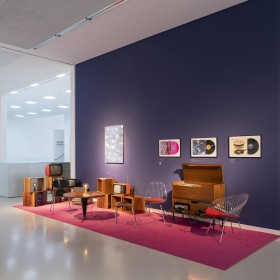
Schifano completes the first works in his new series Paesaggio TV.
1974
The first major retrospective of the artist’s work is held at the Palazzo della Pilotta (Salone delle Scuderie) in Parma.
1975
In April, Schifano is arrested again for possession of opiates. To avoid a prison sentence, he decides to undergo temporary treatment at the Santa Maria della Pietà psychiatric hospital in Rome.
1978
Participation in the 38th Venice Art Biennale
1978–81
In poor health and physically weakened, Schifano mainly produces works on paper.
1981
Stay and drug withdrawal at the Montello di Roma clinic.
1982
Schifano meets Monica De Bei, whom he marries shortly afterwards.
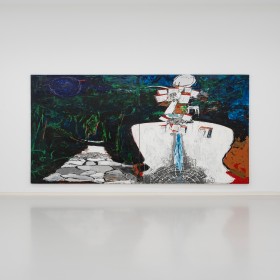
New cycles of works with expressive gestures emerge, revealing stylistic similarities to the Transavanguardia. He further develops his landscape theme from the 1960s, creating works inspired by Claude Monet’s water lily paintings.
1984
Participation in the 41st Venice Art Biennale
1985
In Florence, Schifano paints the monumental work La Chimera in front of 6,000 spectators during a live performance.
Following the birth of his son, Marco, motifs from the world of toys find their way into Schifano’s art.
1989
Schifano designs the jerseys for the leaders of each discipline in the Tour de France, as well as the yellow jersey for the overall leader.
1991
Schifano increasingly addresses political themes, such as the Gulf War, in his works.
1993
A separate room is dedicated to Schifano in the main exhibition of the 45th Venice Art Biennale.
1995
Schifano enters into a partnership with the Italian teleshopping channel Telemarket, producing a series of works for its sales program.
1998
On January 26, Mario Schifano Mario Schifano dies of a heart attack in Rome.