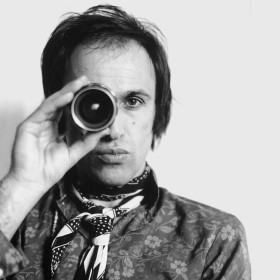
In early December 1963, Schifano travels to New York with his partner at the time, the actress Anita Pallenberg, and spends several months there. He sets up a studio in a former dance studio in Manhattan. Through the poet Frank O’Hara and the painter Jasper Johns, who live in the same building, Schifano makes contacts in the New York art scene. He meets artists such as Jim Dine and Andy Warhol, whose Factory he visits several times. “If I weren’t Andy Warhol, I’d like to be Mario Schifano,” Warhol is said to have remarked at the time—a statement that aptly reflects their mutual fascination.
Although there are parallels between the works of both artists, Schifano’s approach develops independently of American Pop Art—and, importantly, more than a year before his stay in the United States.
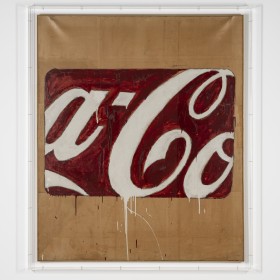
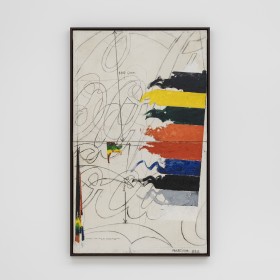
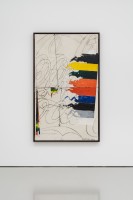
Quadro dedicato ai pittori di insegne (1964) is created during his time in New York. It features fragments of the Coca-Cola logo, laid out as in a preliminary sketch, with measurements, color samples, and a “trademark” note next to the artist’s signature. Through the dedication in the title (English: Picture Dedicated to Sign Painters), Schifano alludes to the traditional craft of painting advertising and shop signs by hand. At the same time, the title can be read as an ironic commentary on the polished advertising aesthetics of many American Pop artists. In contrast, Schifano is concerned with the visibly processual, unfinished character of the painting and the traces of the artist’s hand. The colored stripes on the right edge of the picture are reminiscent of color tests and draw the viewer’s attention to the creation of the picture itself. Thus, his Pop Art remains deeply rooted in painting.
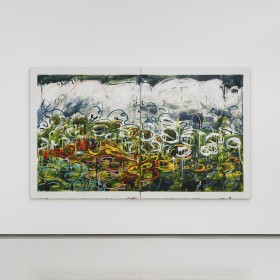
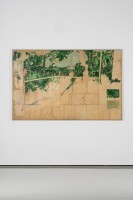
With Central Park East (1964), Schifano turns to a new yet traditional theme: landscape. On a collaged background of sheets of packing paper, glazed layers of paint in various shades of green are clearly recognizable as dripping brushstrokes. While vague associations with a park landscape arise, the motif remains undefined. Instead of a naturalistic representation of the New York park, Schifano is again interested in the image as a physical object: It is a surface on which color, material, and movement interact.
Ileana Sonnabend, the influential gallerist with whom he had been under contract since 1961, is not impressed by this development in Schifano’s work and ends their collaboration in 1963. She also ensures that he has no access to the international market. The artist is not deterred by this. After returning to Rome, he begins a phase of extraordinary productivity and experimentation.