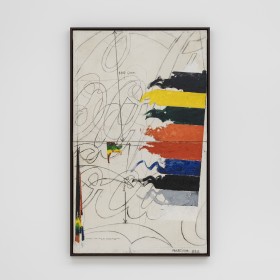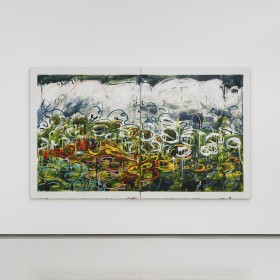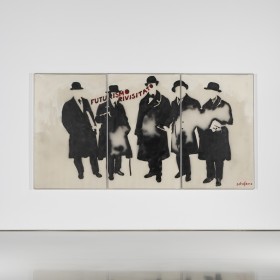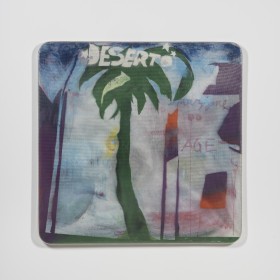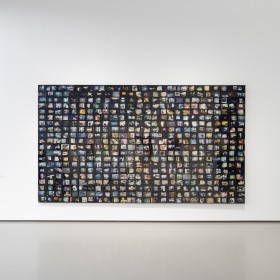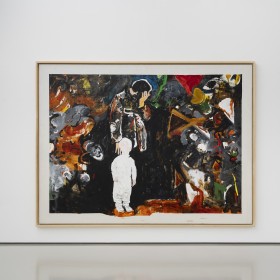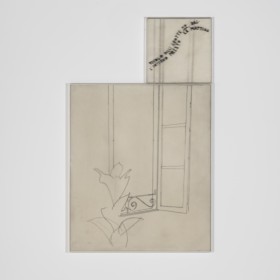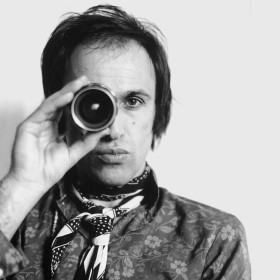
Landscape is one of the central themes in Schifano’s work. This motif, which the artist repeatedly changes and reexamines, runs through his entire oeuvre.
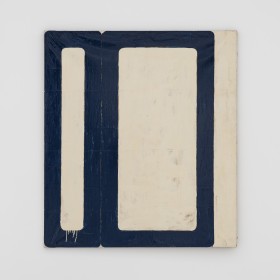
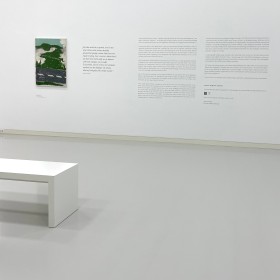
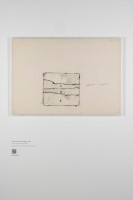
Schifano’s early landscapes emerge from his Monocromi series. In Particolare di paesaggio (1963), his approach becomes apparent: He is not concerned with the naturalistic reproduction of a landscape, but with its construction. Set in a rectangle with rounded corners reminiscent of a camera viewfinder, nature becomes a detail and a highly simplified composition. The word “particolare” (Englisch: detail) appears in several of Schifano’s works, indicating that the representation of a landscape is always just a detail that simulates the limits of human vision—or rather, as in this case, the viewfinder of a camera.
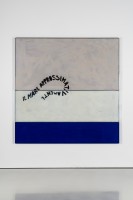
Il mare approssimativamente (1965) consists of three canvases hung one above the other, covered with rough white brushstrokes and encased in three differently colored acrylic glass hoods. The sea appears only as an idea, as a construction, at a conscious distance. The spray-painted title (English: The Sea, Approximately) ironically alludes to the impossibility of actually depicting nature. Painting is always an approximation, never an exact replica. Schifano explains, “I prefer works that leave a lot of room for interpretation. Basically, even a landscape painting is an abstract image.”
Il mare approssimativamente is reduced to the essentials: water, horizon, sky, and colors. The landscape is emptied. Schifano also titles many of these highly reduced landscape paintings Paesaggio anemico (Englisch: Anemic Landscape). The reduction of pictorial elements and the artificial color and materiality of the acrylic glass emphasize that what is depicted here is not nature itself, but rather an image of a landscape.
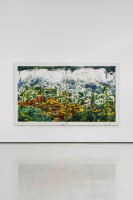
In addition to acrylic glass and words placed within the picture, Schifano often uses framing forms that likewise function as filters. They mark the distance between the eye and reality, visualizing the fact that every painted landscape is a mediation, an image of an image. Such “frames” are particularly evident in many of his later landscapes, including Acquatico (1983) and Vena madre (1985). In both works, the gestural painting is framed on all sides by a white strip of unpainted canvas.
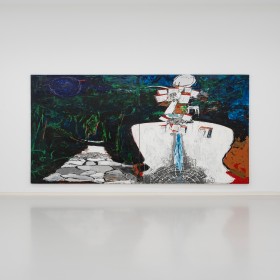
After the photographically influenced 1970s, Schifano rediscovers pure painting in the 1980s. His works from this period are spontaneous, physical, and lively, testifying to a new zest for color and gesture. The canvases are large in format, and the paint is often impasto, sometimes applied directly from the tube.
Acquatico is one of a series of works that take up and reinterpret the famous water lily paintings of the French Impressionist Claude Monet. The colorful, dripping swirls—which testify to the speed and dynamism of the creative process—do not mimic but merely allude to the water lily motif.
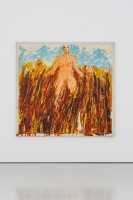
Vena madre depicts a naked woman in a cornfield and can be interpreted as a visualization of fertility. Created in the year his son Marco is born, the work falls within a period of personal renewal following difficult years and drug rehabilitation. These landscapes exude vitality in their execution, which is also alluded to by the mystical motif. At the same time, the works of these years are also a reaction to the Italian Transavanguardia movement and Neo-Expressionism, which at that time stood for a return to expressive painting.