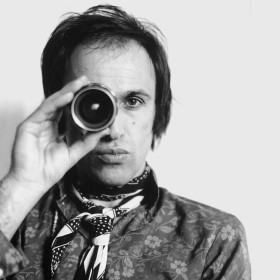
The 1960s are also a decade of upheaval and contradictions in Italy: Economic boom, youth culture, and protest movements shake the old value system. Schifano, rebellious and restless, embodies this zeitgeist like no other. In Rome, he becomes the darling of the jet set, his studio the center of the scene. He lives intensely and uncompromisingly. His excessive drug use and mental health crises earn him the reputation of a “maledetto,” or “cursed” artist. Schifano is arrested several times for drug possession and spends time in prison and clinics.
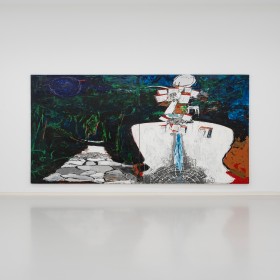
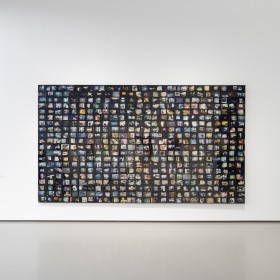
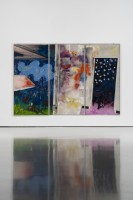
The three-part Ospedale (1970) is a portrait of this era. In it, Schifano paints over a photograph of a hospital corridor, transforming it into a chaotic image in which day and night confront each other. The work is covered with words and scribbles, including names of lovers, sexual allusions, political symbols, hearts, and stars—his own trademark. The work evokes associations with drug trips, expansion of consciousness, and hallucinations—experiences that are consciously sought out in the counterculture of these years.
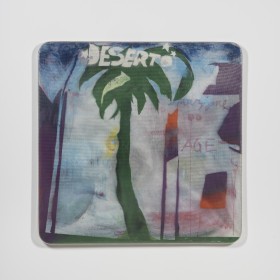
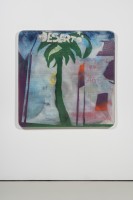
Particolare di deserto (1966) also has an intoxicating effect. A ribbed acrylic glass hood lies like a veil over the painting. The motif of the green palm tree appears shimmering and intangible. Words such as “Mary Jane” (slang for marijuana) clearly allude to drug use. As Schifano himself emphasizes, the palm tree does not represent his Libyan origins, but rather functions as a modern, memorable figure with a trademark function. The same applies to his star pictures, such as Tuttestelle (1967). Applied with stencils and spray paint and presented under acrylic glass, the stars become symbols of a psychedelic and simultaneously universal visual world.
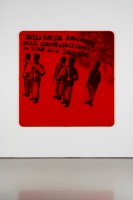
With Compagni compagni (1968), Schifano responds to the political tensions of his time. The cycle features several worker figures carrying the iconic symbols of communism: the hammer and sickle. The title references the slogans of the demonstrations. At the same time, the lettering in the picture alludes to Mao Zedong’s influential essay, “On the Correct Handling of Contradictions Among the People.” In Italy at that time, student protests and workers’ struggles converged in a united resistance against capitalist exploitation. In its coloring, the orange-red acrylic glass also refers to the labor movement and the revolutionary left. However, Schifano remains an observer, fascinated by the power of symbols and their effect, rather than by the political doctrine they embody.